Tampilkan postingan dengan label Traditional. Tampilkan semua postingan

Selasa, 16 Juni 2020

Traditional Cornish Splits


If I was a much better, more dedicated to my craft blogger, you would never see photos like these.  I Would take the time to pipe the cream into the buns so that everything looked all nice and pretty, setting the shot up perfectly with teapots and cups and tea clothes, etc.


That's not me.  I tend to just show you things as they are.  Simple without too many frills and not overly fancied up. Not that there is anything wrong with fancying things up a bit. That's just not me.


Besides today, by the time I got these done, it was getting late, I was losing the light and to be honest I was beat, beat, beat.  I actually started these about 6:30 this morning.  I had three other recipes to do for another site and so I had to fit them all in while I still had the light with me.


But you don't want to know about all of that . . .  you want to know about these tasty buns.  Cornish Splits.  I am sure you have all heard of Cream Teas, or Cornish Teas/Devon Teas.


A delightful repast of  fresh scones served with butter, jam and clotted cream, washed down with cups of hot tea.  Well, before they ever included scones,  these lovely light yeasted buns were the original stars of a Cream Tea.


I am not surprised.  Light as air, only slightly sweetened, like soft yeasted pillows of deliciousness . . .  perfect for spreading with soft butter and jam, and topped with lashings of clotted cream . . .  a slight dusting of icing sugar garnishing the tops.


I can well imagine how delightful they would be with hot cups of tea.  We don't drink tea for religious reasons, and somehow I don't think herbal tea would be quite the same.


These are such a simple make/bake. Seriously.  One kneading and rising.  Shape into balls, a quick rise and then bake.


The rolls are lovely and light textured and I imagine very nice just on their own, split, toasted and spread with butter  . . . and maybe some jam . . .


You can eat the while they are still slightly warm if you wish, in which case I think the butter would melt into the beautiful texture of those light airy buns  . . .


We enjoyed them cold, split and filled to the hilt with the strawberry jam and whipped cream.


We have not been able to get out shopping so there was no clotted cream.  The whipped cream was very nice however.


The jam,  Bonne Maman  . . .  not having any homemade jam, I used the next best thing . . . . which is Bonne Maman . . .


The French make beautiful jams . . .  and breads for that matter  . . .


Dusted with icing sugar, these were exquisite.

Traditional Cornish Splits

Print
Traditional Cornish Splits
Yield: 8
Author:
Classically  Cornish teatime treats. Light and airy yeasted buns, served split, spread with butter and topped with lashings of jam and cream.  If you fill them with clotted cream and golden syrup, they become Thunder and Lightening, a real favourite with kiddies everywhere!

Ingredients:

For the buns:
  • 305g strong bread flour (2 1/4 cups)
  • 1/2 tsp fine sea salt
  • 4 1/2 tsp easy yeast (bread machine yeast)
  • 1 TBS white sugar
  • 2 TBS butter
  • 300ml whole milk (1 1/4 cup)
To serve:
  • softened butter to spread
  • Softly whipped sweetened cream, or clotted cream
  • strawberry jam
  • icing sugar to dust

Instructions:

  1. Fit a stand mixer with a kneading hook.  Measure the flour, sugar, salt, yeast and sugar into the bowl of the stand mixer and mix to combine.
  2. Warm the milk in the microwave with the butter for about 30 seconds. Just long enough to melt the butter. You don't want any of it to be hot, just blood warm.
  3. Start drizzling the milk/butter mixture into the bowl of the stand mixer, with it turned on low, until it is all added and incorporated. Keep the motor running until you get a soft, slightly tacky dough. You may need to add a bit more flour. (Today I needed to add another 35g/1/4 cup).
  4. Tip into a greased bowl and cover with plastic cling film. Set aside to prove for an hour or so until it doubles in size.  Turn onto a lightly floured  board and divide into 8 equal pieces. (I shape it into a circle and cut it into 8 wedges.)  Shape each piece into a ball and place onto a large baking sheet you have lined with baking paper. Dust lightly with flour, cover with a tea towel and set aside to rise for 15 minutes.
  5. Preheat the oven to 190*C/375*F/ gas mark 5.
  6. Bake the buns in the preheated oven for between 15 and 20 minutes until a pale golden brown. If you tip one over it should sound hollow when tapped on the bottom. If not, return to the oven for a few more minutes.
  7. To serve. split almost all the way through on the diagonal.  Spread the bottoms with softened butter, top with plenty of strawberry jam and a nice thick dollop of whipped double cream or clotted cream. Dust the tops with some icing sugar and serve immediately.
  8. These can be served slightly warm or cold. Best served on the day.  Don't fill until you are ready to serve them.
Did you make this recipe?
Tag @marierayner5530 on instagram and hashtag it #EnglishKitchen
Created using The Recipes Generator


I sent half of these next door to my neighbour. She and her son have been ever so good to us throughout this pandemic, always picking up bread and milk, even if we have not asked for it, and she won't take any compensation for it.  I figure the least I can do is to bake them treats every now and then! 


Read more

Sabtu, 06 Juni 2020

Grandmother's Steamed Brown Bread, small batch


For as long as I can remember and beyond Saturday night suppers back home in Nova Scotia and indeed all down the Eastern part of Canada and the US, Saturday night baked bean suppers have been the tradition.


In fact, during non-covid days, Baked Bean Suppers have always been huge fund raisers for local communities, volunteer fire departments, schools, etc.  People have always loved them.


Back where I come from Baked Beans are not humble, they are precious and speak of family, tradition and community spirit. Baked Bean Suppers, with home baked beans, ham or hotdogs, scalloped potatoes and steamed brown bread, or sometimes molasses oatmeal bread, or baking powder biscuits, or even corn bread.  These are knit into very the fibre of every maritimer.


Brown Bread is probably the most basic traditional bread served with baked beans.  Back home you can buy it in cans, baked and ready to re-heat by steaming.  Or you can make your own, which is very easy.


I had not made Brown Bread in years.  Most of all because there are only two of us in our home now. You can't get the big coffee cans I used to steam it in over here in the UK, and to be honest most tin cans here are not the right kind. They have an extra lip  on the upper side, which prevents you from just slipping things you bake/steam in them out.


It was something I was craving today however  . . .  a Baked Bean Supper . . .  and I wanted Brown Bread with it and so I decided to take my old recipe and cut it in half to make a smaller batch.


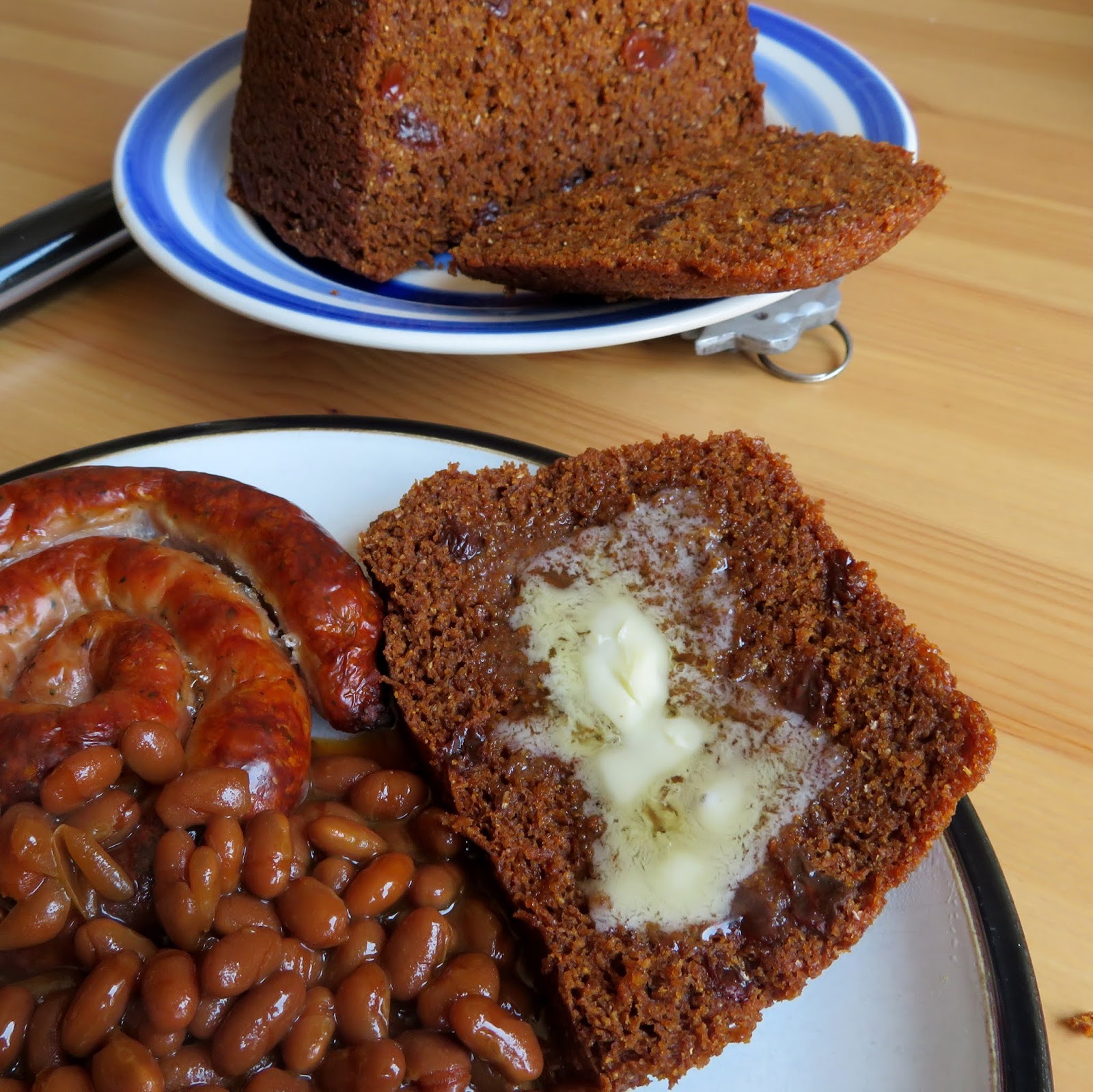
I was really pleased with the results!  It turned out beautifully!  I used a 3 1/2 cup pudding basin (Mason Cash) to steam it in.  I steamed it in the top part of my double boiler/steamer.


No, its not the traditional shape that you will usually see Brown Bread being  . . .  but the taste is all there.  The texture is all there.  The smell is all there  . . .


I didn't have any hotdogs to enjoy with it and my baked beans, but I did have some Cumberland Sausage wheels that I thought would work just as well . . .  they did.


Just look at that beautiful texure.  This was amazingly delicious  . . .


Especially spread with some cold butter  . . .  the richness of butter, melting down into that beautiful bread . . .


Rich and moreish, studded with little sticky raisins, perfect with the baked beans  . . .  it doesn't get much better than this . . .


Grandmother's Steamed Brown Bread
Print

Grandmother's Steamed Brown Bread

Yield: Makes 1 small loaf
Author:
Brown bread traditionally has been served with baked beans all up and down the East Coast of North America.  This is a delicious whole grain loaf, studded with raisins, that you steam.  This is a small batch recipe.

Ingredients:

  • 70g whole wheat flour (1/2 cup)
  • 70g rye flour (1/2 cup)
  • 85g cornmeal (1/2 cup)
  • 3/4 tsp bicarbonate of soda
  • 1/2 tsp salt
  • 85g molasses (3 fluid ounces)
  • 120g sour cream (1 cup)
  • 75g sultanas or raisins (1/2 cup)
  • a knob of butter to butter the pudding basin

Instructions:

  1. Have ready a large double boiler/steamer, fitted with a basket and a lid.  Fill the bottom with boiling water and keep warm.  Butter a 3 1/2 to 4 cup cylindrical mold or pudding basin well. Pleat a sheet of aluminium foil, large enough to cover the basin and set aside.
  2. Whisk all of the dry ingredients together in a bowl.  Stir in the raisins. Whisk the wet ingredients together in another bowl. Add to the dry ingredients and mix to combine well.
  3. Spoon into the pudding basin/mold to come 2/3 of the way up the bowl. Cover it with the buttered foil, butter side down and seal the edges around the boil. Tie it with some string.
  4. Place into the steamer pot and cover tightly with a lid.  Steam for 2 to 3 hours, topping up the pan with water as needed. When done a toothpick inserted in the centre should come out clean.
  5. Unmold onto a plate and serve warm, slathered with butter.  Delicious!
Did you make this recipe?
Tag @marierayner5530 on instagram and hashtag it #EnglishKitchen
Created using The Recipes Generator


Scalloped Potatoes on the side made this meal complete.  The only thing missing was my mother's Green Tomato Chow and a slab of Lemon Meringue Pie.   


Read more

Minggu, 29 Maret 2020

English Muffins


In January I started writing on another site called Home Chef World.  I was hired to provide them with between 4 and 8 recipe posts a month.  This is in addition to what I share here.   I have really enjoyed doing it thus far and I hope this lasts a long longer than my other job did.  One never knows with the unstable world we are living in at the moment, but one thing is for sure, people will always want and need to eat.


One of the recipes I will be sharing on there over this next month required English Muffins.  Do you think I could find any?  None to be had anywhere, and I tried.  We are living in precarious times and I have realised that certain things have become very difficult to find.  One is flour (we won't talk about toilet paper). 


I am rationing my flour out very carefully because I don't know how long it will be before I can get any more.  It has become a very precious commodity in this house.


I did a lot of research before I picked a recipe to try.  I am not the most experienced bread baker and my results have always tended to be a bit hit and miss.  I found this recipe on a site called Bigger Bolder Baking.  It also had a video, and quite a few good reviews, so I felt fairly confident in using this recipe


It differed a bit somewhat in the English Muffins I am used to in that there is no cornmeal or semolina involved. Some recipes use this to keep the dough from sticking to things.  You do need to start it 18 hours prior to when you want to bake/grill them.


You do not need an oven for these. They cook entirely on top of the stove in a large non-stick skillet with a lid.  I found that my dough was a tiny bit drier than what hers looked like, so I was a bit worried that it wouldn't turn out, but my fears were completely unfounded.  It was perfect.


They cooked very easily in my largest skillet.  I was going to use my griddle pan until I realised I didn't have a lid to cover it. DUH. 


Using a lid to cover the muffins while they are first baking is integral to the success of the recipe.  This action allows them to rise higher and to cook thoroughly.


You might be interested to know that English Muffins are not really English at all, although they were invented by an English Ex Pat, living in New York City named Samuel Bath Thomas back in 1874.


Invented in America by an Englishman.  He owned a bakery known as Chelsea (could there be a more British name?) and were originally called Toaster Crumpets.


They were very quick to catch on and became very popular in Hotels and restaurants, soon taking on the name of "English Muffins."


The best way to open up an English Muffin is to run the tines of a fork into them all around the centre of the circumferance of the warm muffins.  Once you have done that. it is very easy to gently pull them apart.


This helps to prevent them from being squashed . . .  they are filled with lovely butter catching holes, nooks and crannies and separating them with a fork helps to create even more.


Oh my  . . .  I have fallen in love. Their texture was beautiful.  Todd enjoyed one later on, toasted on the open side under the hot grill and those little nooks and crannies, toasted up really nicely.


Just beautiful . . . . I enjoyed one warm from the oven with some cold butter thinly sliced over top . . . .


and some Bonne Maman Intense strawberry jam.  Oh boy, but this was sooooo good!


They were light and fluffy, beautifully golden brown on the outside and crisp at the edges  . . .


I could find no fault with them, no fault at all  . . .


In fact the worst thing I have to say about these is that once you have tried one  you will never ever be happy again with a ready made one. Never ever.

English Muffins

English Muffins

Yield: makes 8 to 10
Author:
These are fabulous.  The worst thing you can say about them is that once you eat one of these you will be forever spoilt from ever enjoying a store made muffin again. You will need to start these the day before.

Ingredients:

  • 350g strong bread flour (2 1/2 cups)
  • 1/4 tsp bread machine yeast
  • 1/4 tsp fine sea salt
  • 160ml milk (2/3 cup)
  • 120ml water (1/2 cup)
  • 1 TBS salted butter

Instructions:

How to cook English Muffins

  1. Sift the flour into a large bowl.  Add the yeast on one side of the bowl and the salt on the other. Don't let them touch as salt kills yeast. Mix lightly together.
  2. Measure the milk and water into a microwave safe jug. Add the butter. Cook for about 30 seconds in the microwave to melt the butter and slightly warm the milk mixture.  The temperature should be only blood warm.  Take care not to over heat.
  3. Holding some of the liquid mixture back, stir it into the dry mixture, adding only enough to give you  a soft dough. It may be a bit sticky, and you may not need it all.  Cover bowl with a sheet of plastic cling film and then cover with a clean tea towel.  Set aside in a warm, draft free place for 12 to 18 hours.  (You can refrigerate the dough after 18 hours if you are not quite ready to griddle them.)
  4. When you are ready to bake, dust a surface lightly with flour.  Scrape the dough out onto the surface.  Recover with the cling film and kitchen towel.  Let rest for 10 minutes. 
  5. Line a baking tray with baking parchment.
  6. At the end of the rest time, gently pat out to a thickness of about 1 inch.  Using a  sharp 3 inch round metal cutter dusted in flour, stamp out rounds, removing and placing them onto the baking sheet as you cut them out, leaving plenty of space in between.  Continue until you have cut all the rounds out.  Any scraps leftover can be rerolled and cut into rounds, although they won't be quite as perfect in appearance as the others.
  7. Cover the muffins with cling film and the kitchen towel and set aside to rest for 45 minutes.
  8. At the end of that time heat a large non-stick skillet over medium low heat. It should feel quite warm when you hold your hand just above the surface.  Working in batches, carefully remove the muffins from the baking sheet, about 4 at a time, and transfer them into the heated pan.   Do not crowd them. Leave at least 2 inches between each muffin. Cover with a lid and cook for about 6 to 7 minutes until golden brown on the underside.  Having the lid on will create steam which will help the muffins to rise and cook thoroughly.
  9. Once the underside is golden brown, carefully flip over and toast on the other side.
  10. Set aside to let them cool slightly before eating.  I like to split them in half  using a fork, sticking it carefully into the centre of the muffins all the way around and gently pulling them apart.  This gives you lots of craggy bits.  Serve warm with butter and jam.
  11. Any leftovers can be stored in an airtight container for up to 4 days.  Split and toast in a toaster or under the grill. You make also freeze the in an airtight container for up to 2 months.

Did you make this recipe?
Tag @marierayner5530 on instagram and hashtag it #EnglishKitchen
Created using The Recipes Generator


In fact these are so good thatI think that I may have to make some again really soon.  I highly recommend! 


Read more